Digital Estate Planning: How to Protect What Matters When You Can't Be There
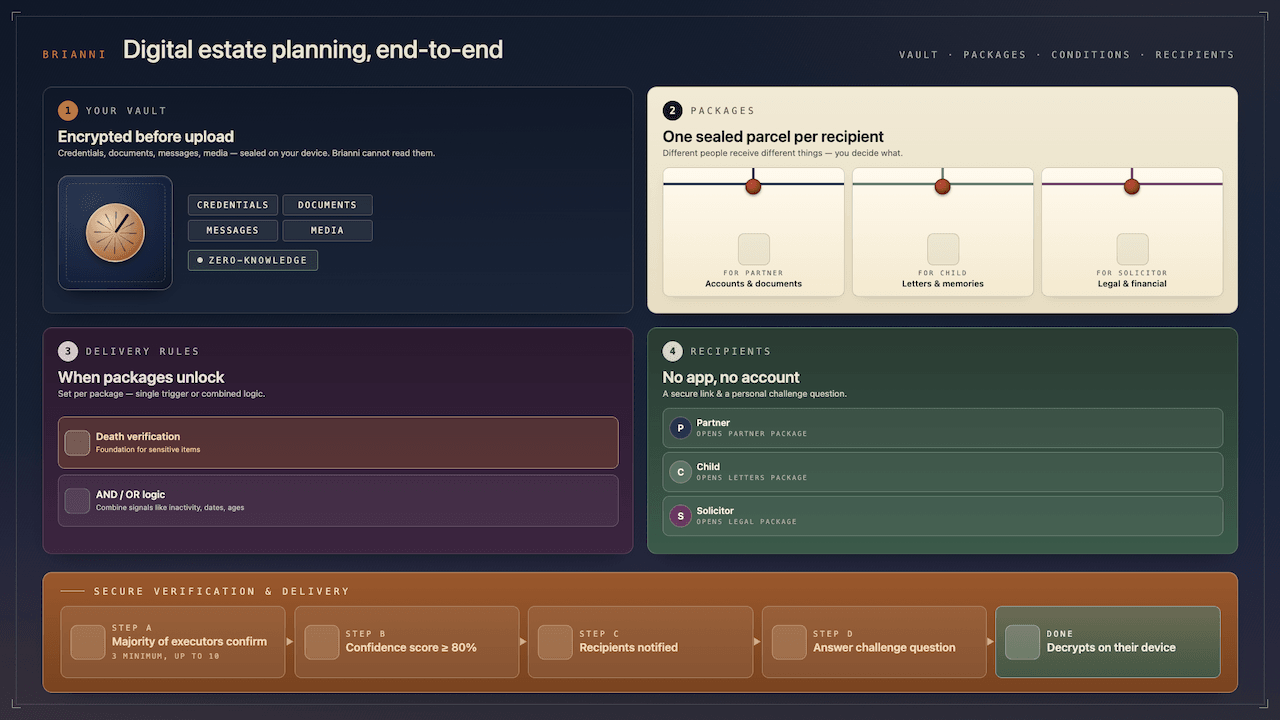
Digital estate planning is about one simple thing:
Making sure the right people can access the right parts of your digital life — at the right time — if you're no longer able to manage it yourself.
Passwords. Documents. Photos. Messages. Financial records.
Most people know this matters. Almost nobody actually does it.
Not because they don't care — but because the options available are either insecure, impractical, or uncomfortable to set up.
Why This Is Harder Than It Should Be
Most people start with one of these approaches.
The shared document
A Google Doc or spreadsheet with passwords and account details. It works… until it doesn't.
- It's not properly encrypted
- It goes out of date quickly
- Anyone with access gets everything
There's no control, no conditions, and no real security.
The sealed envelope
Write it down. Put it in a safe. Tell someone where it is.
Better than nothing — but fragile.
- Paper becomes outdated
- Access depends on someone finding it
- It doesn't scale with a digital life
Password manager "emergency access"
Closer to the right idea. Some password managers allow a trusted contact to request access if you don't respond.
But it only covers passwords — not documents, messages, or media — and often relies on trust in the provider during transfer.
"I'll sort it out later"
The most common approach. And the one that causes the most problems.
Families end up trying to reconstruct a digital life from fragments — accounts, emails, subscriptions — often over months.
What's Missing
A proper digital estate plan needs three things:
- Encryption the platform cannot break
- Delivery that doesn't depend on you remembering
- Verification that prevents false triggers
Most solutions handle one, sometimes two. Very few handle all three.
That's the gap Brianni is designed to fill.
How Digital Estate Planning Works on Brianni
The model is straightforward:
- Store your important items in an encrypted vault
- Group them into packages for specific people
- Define when those packages should be delivered
- Assign trusted executors to verify events
Each part works independently — and together.
1. Store What Matters in Your Vault
Your vault is your encrypted archive. Everything is encrypted on your device before upload. Brianni cannot read your content.
For estate planning, most items fall into four categories:
Credentials. Bank accounts, email, subscriptions, crypto wallets — anything someone would need to access or close.
Documents. Insurance policies, wills, tax records, contracts, medical directives.
Personal messages. Letters to specific people. Things you want to say in your own words that don't belong in a legal document.
Photos and videos. Family media, recordings, anything that shouldn't be lost.
Organise clearly. Use titles and tags like financial, legal, family, personal. This makes everything easier later.
2. Create Packages for Specific People
A package is a sealed set of items for one recipient. This is where estate planning becomes precise.
Different people get different things:
- Partner → accounts, documents, personal messages
- Children → messages, memories, selected access
- Solicitor → legal and financial documents
- Friends → personal notes
Each package has its own recipient, its own delivery conditions, and its own access control. You decide exactly who gets what.
3. Set Delivery Conditions
Instead of relying on someone to "find" things, you define when they become available.
For estate planning, the key options are:
Death Verification. Delivery happens only after a verified process confirms your passing. The most secure option for sensitive data.
Inactivity (via Complex Logic). Triggers if you haven't been active for a defined period. Useful for scenarios like incapacitation.
Combined Conditions. Combine multiple signals with AND/OR logic. For example: "Inactive for 60 days AND executor confirmation" or "Age 21 OR death verification."
For most plans, Death Verification is the foundation.
4. Appoint Executors
Executors confirm that something has happened to you. They do not access your data — they only trigger the verification process.
Once verified, an executor cannot view your vault, your packages, or your recipients. They have exactly one capability: confirming you've passed away.
Choosing executors. Pick people who would reliably know if something happened, and whom you trust to act responsibly. Often a partner, sibling, close friend, or solicitor.
How it works. Add executors. They verify their identity. They can submit a report if needed.
Minimum: three verified executors for secure confirmation.
5. Understand the Verification Process
False triggers are the biggest risk in digital estate systems. Brianni is designed to prevent them.
When a report is submitted, the system evaluates several signals:
- Executor consensus — independent confirmations from multiple executors
- Device inactivity — lack of recent activity across your devices
- Heartbeat checks — automated attempts to contact you
- Response signals — any sign you're still active
Each signal contributes to a confidence score on a 0–100% scale, and the outcome depends on both the score and how the executors have responded:
- 80% or above, with every executor having responded → immediate auto-approval; delivery is authorised
- 80% or above, with some executors still to respond → a 12-hour wait period before approval, giving everyone time to weigh in
- Any executor challenges the report → automatic manual review by Brianni's trust and safety team, regardless of score
- Below 80% → the system holds and waits for more confirmations
At no point does Brianni access your content. Verification controls whether delivery happens — not what gets delivered.
6. Set Challenge Questions
Recipients unlock packages by answering a personal question. The answer is never sent to Brianni's servers — it's used locally on the recipient's device to derive the decryption key. Either it unlocks the content, or it doesn't.
Choose questions that are meaningful and not easily guessed:
- "What was the first meal I cooked for you?"
- "What did you name your first stuffed animal?"
- "What's the code word we agreed on at our January meeting?"
Shared memories, personal references, or pre-agreed phrases all work well.
What Recipients Experience
When the time comes:
- Executors confirm independently
- Verification runs
- Delivery is authorised
Each recipient gets a notification with a secure link. They don't need a Brianni account. They don't need to download an app.
They open the link in a browser, answer the challenge question, and the content decrypts on their device. Each person sees only what was intended for them — nothing more.
A Practical Setup Checklist
You can do this in an afternoon.
Hour 1 — Inventory. List the key accounts, documents, and items that someone would need.
Hour 2 — Upload. Add them to your vault. Use clear titles and tags.
Hour 3 — Structure. Create packages. Assign recipients. Add executors.
Ongoing. Keep things updated as life changes.
What This Costs
Brianni has three consumer tiers, all priced in GBP:
- Free. 10 GB encrypted storage, up to 5 recipients, and all living delivery conditions like scheduled and immediate delivery. No executors, no death verification.
- Personal — £19/year (or £1.99/month). 50 GB encrypted storage, unlimited vault items and recipients, death verification, and up to 5 trusted executors. This is the entry point for most estate plans.
- Professional — £49/year (or £4.99/month). 200 GB encrypted storage, up to 10 trusted executors, and complex delivery rules (AND/OR logic — e.g. "inactive for 60 days AND executor confirmation"). The right tier when you need elaborate conditions or more than five executors.
If you're a solicitor, will-writer, financial advisor, or wealth manager helping clients with digital legacy planning, there's also a separate B2B offering — Brianni for Advisors — which lets your firm send branded client invites, track onboarding, and be appointed as a professional executor inside the same multi-executor consensus model.
Why Zero-Knowledge Matters
Most tools rely on trust:
"We won't access your data."
Zero-knowledge changes that to:
"We can't."
Your encryption key never leaves your device. Even if the platform is compromised, your data remains sealed.
For estate planning, this isn't optional — it's foundational. You're making arrangements for a time when you can't oversee them. The encryption ensures those arrangements are tamper-proof, platform-proof, and private — from the moment you seal them until the moment they're opened by the people you chose.
Getting Started
Start at brianni.co.
Set up your vault. Add your first package. Invite one executor.
You don't need a perfect plan to begin. You just need to start.