Why I Built Brianni: The Gap Nobody Talked About
Six months ago, I went looking for something simple: a way to store something privately and have it reach the right person at the right time.
The question became more concrete:
If something happened to me tomorrow, would the right people be able to access what matters — without me giving up my privacy today?
The answer was no.
Not because the technology didn’t exist. But because it existed in forms that were never designed to work together.
Two Systems, Two Trade-offs
There are two categories that matter here.
The first is zero-knowledge storage.
These systems represent the strongest form of privacy we have today. Your data is encrypted in a way that even the platform cannot access. No internal visibility. No silent access. No dependency on policy.
But they are passive by design.
They store data securely, but they don’t act on it. They have no concept of when something should happen, or who should receive it under changing conditions. If access needs to change in the future, the burden falls back on you.
In practice, people work around this:
- sharing credentials
- duplicating sensitive data
- relying on instructions that may never be followed
The system is secure. The outcome is not.
The second category is delivery systems.
Scheduled messages. Time capsules. Conditional triggers. Legacy tools.
These systems understand time. They allow you to define when something should be delivered, and under what conditions.
But they rely on visibility.
The platform can access what you store. That means your privacy depends not on cryptography, but on trust — trust that the system behaves correctly, and continues to do so indefinitely.
So you are forced into a trade-off:
- Privacy without delivery
- Delivery without privacy
That trade-off isn’t technical. It’s architectural.
And it shouldn’t exist.
The Missing Category
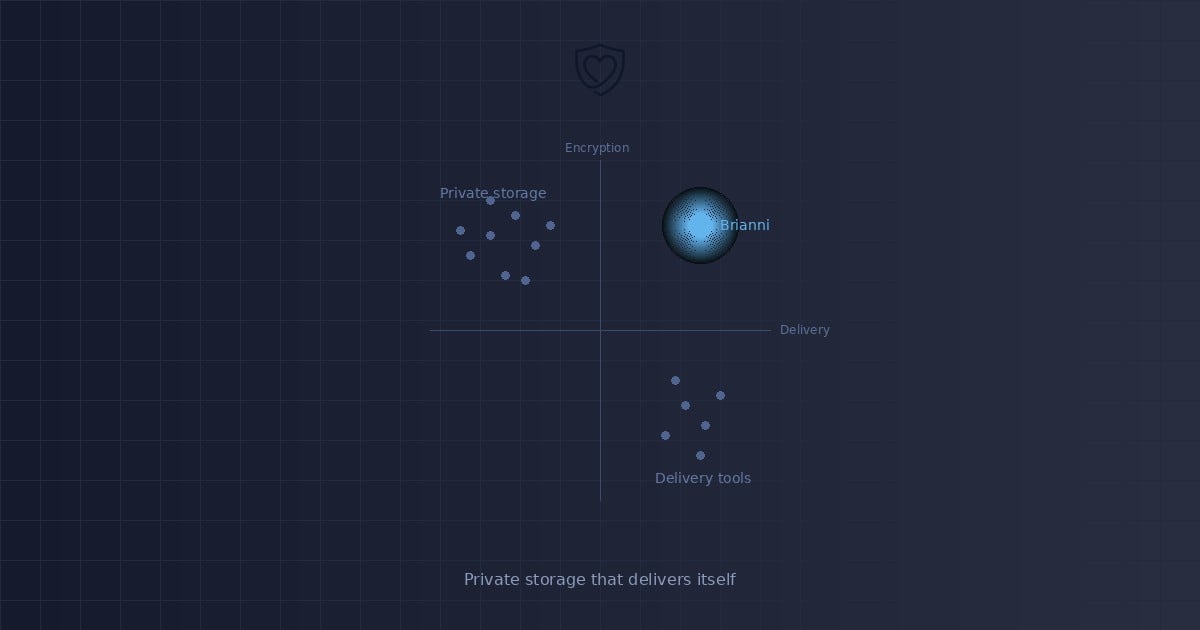
I mapped the landscape directly.
- Zero-knowledge storage: no conditional delivery
- Delivery platforms: no true zero-knowledge guarantees
- Ecosystem-bound solutions: limited by device or account dependencies
Even adjacent tools fall short:
- Password managers allow sharing, but not programmable delivery
- Trigger-based tools can act, but don’t preserve true zero-knowledge
- Platform-native features break outside their ecosystem
What didn’t exist was a system that combined all three:
Zero-knowledge encryption + programmable conditional delivery + cross-device access without friction
That’s not a feature gap.
That’s a missing category.
Designing a System That Can Act Without Seeing
The challenge wasn’t storage. It was execution.
If a system cannot see your data, it cannot decide what to do with it.
So the model had to change.
Brianni moves execution away from the server and into the client:
- Encryption and decryption happen entirely on user devices
- Delivery conditions are evaluated client-side
- The platform coordinates storage and verification, without accessing content
This creates a different kind of system:
- One that can prove conditions were met
- One that allows recipients to securely decrypt content
- One where the platform never has visibility into what is stored
On top of this, Brianni introduces a programmable delivery layer:
- Scheduled releases (dates, anniversaries)
- Recurring conditions
- Age-based access
- Manual triggers
- Multi-executor verification
- Composable logic (AND / OR conditions)
Each layer expands capability without weakening privacy.
Why This Category Exists Now
For a long time, these two problems — privacy and delivery — were solved separately.
Not because they were unrelated, but because combining them required a different architecture entirely.
Most systems centralise control on the server. That model breaks the moment you introduce true zero-knowledge encryption — because the server can no longer see or act on the data.
Bridging that gap means moving trust, execution, and verification to the client, while still maintaining reliability across devices and environments.
That’s not an incremental change. It’s a fundamental shift in how these systems are designed.
This is why the intersection remained empty.
Designed for Real Life, Not Ideal Systems
Most platforms assume a controlled environment.
The same devices. The same ecosystem. The same assumptions about how users behave.
Reality doesn’t work that way.
People live across platforms. Families use different devices. Important moments don’t wait for the right app to be installed.
Brianni is designed for that reality:
- Full access across web, iOS, and Android
- No requirement for recipients to install anything
- No dependency on shared ecosystems
Recipients receive a secure link, verify once, and access everything from their browser.
No setup. No lock-in. No friction.
What People Actually Do With It
The most interesting insight came from early users.
This isn’t just about edge cases or contingency planning.
Yes, some use it for critical scenarios:
- important documents
- access instructions
- sensitive information gated by conditions
But many use it to create moments:
- photo albums that arrive on birthdays
- recurring updates for family members abroad
- portfolios that unlock when milestones are reached
- shared content that releases over time
Brianni isn’t only about preparing for the future.
It’s about using time as part of how information is shared, without giving up privacy.
A New Primitive: Time-Bound Private Data
At its core, Brianni introduces something simple:
Data that is private by default, and released by condition.
Not manually shared. Not permanently accessible. Not dependent on trust.
Just cryptographically private data that becomes available exactly when it should.
That capability doesn’t just apply to individuals.
It extends to:
- agreements that unlock at defined moments
- access that revokes automatically
- information that exists only within a time boundary
This is broader than storage. It’s a new primitive.
What Comes Next
The roadmap expands on this foundation:
- more expressive condition systems
- deeper mobile capabilities
- organisational and enterprise applications
But the core idea remains unchanged:
Private storage that can deliver itself.
If you’ve ever wanted to send something into the future — securely, privately, and without relying on trust — that’s what Brianni enables.
You can try it free at brianni.co.
Zee, Founder of Brianni March 2026